What Is
Artificial intelligence (AI) is becoming a key technology transforming everyday life and business. From chatbots that understand and respond to complex questions, to applications that generate content and analyze data, AI is proving it can handle tasks that were, until recently, possible only for humans. This article looks at what AI actually is, how it works, and how it's used across different fields.
 Етиен Янев
9 min read
updated on 20 August 2026
Warning: foreach() argument must be of type array|object, null given in /home/backlb1j/public_html/etienyanev.com/wp-content/themes/etien-theme/functions.php on line 818
Warning: Trying to access array offset on value of type null in /home/backlb1j/public_html/etienyanev.com/wp-content/themes/etien-theme/functions.php on line 833
Warning: Trying to access array offset on value of type null in /home/backlb1j/public_html/etienyanev.com/wp-content/themes/etien-theme/functions.php on line 833
What is artificial intelligence and how does it work?
Artificial intelligence (AI) is the ability of machines to perform tasks that normally require human intelligence – solving problems, understanding language, and recognizing objects, for example. That’s why AI chatbots have become so popular in business and everyday life: they function like an “intern sitting at the next desk,” ready to carry out instructions.
When we talk about artificial intelligence, it’s worth focusing on two key technologies behind its power: machine learning and natural language processing. What exactly are they? Let’s find out.
- Machine learning: the development of algorithms that let machines learn from data and make predictions. For example, just as a person looks at a canvas of paint and recognizes it as a painting, identifying its style and genre from past experience, artificial intelligence can recognize that a given piece of text is written for posting on LinkedIn.
- Natural language processing: this technology lets artificial intelligence understand and use human language. Thanks to NLP, we can talk to chatbots almost as if they were human.
Artificial intelligence is trained on huge volumes of data, and even our own interactions with chatbots help it improve. The more data AI processes, the more accurate its results become.
There are two main types of artificial intelligence: narrow and general. Narrow AI is built to perform specific tasks within a limited context, like Apple’s voice assistant Siri. General AI, on the other hand, can handle a much wider range of tasks, as with ChatGPT.
How has AI developed in recent years?
Artificial intelligence isn’t new, even though it became a hot topic after ChatGPT arrived in late 2022. The idea of machine thinking dates back to 1950, when British mathematician Alan Turing proposed the concept of machine intelligence in his paper “Can a Machine Think?” In it, he also described the Turing test, a method for evaluating a computer’s intelligence.

Another key moment in the history of artificial intelligence was the chess match between Garry Kasparov and IBM’s Deep Blue. Kasparov won in 1996, but a year later Deep Blue became the first computer to beat a reigning world champion in a straight match. That event changed how we thought about what machines could do.
Today artificial intelligence is evolving at enormous speed. ChatGPT laid the groundwork with text conversations, later adding features like image generation and voice commands. New technologies followed, such as:
- Text-to-image: Midjourney, Dall-E, Stable Diffusion.
- Text-to-voice: ElevenLabs.
- Text-to-video: RunwayML, InVideo, Kling AI
Bulgaria has its own point of pride with BgGPT, the first European chatbot built specifically for the Bulgarian language by INSAIT. By March 2024, BgGPT had answered more than 2 million queries, offering a localized alternative to ChatGPT.
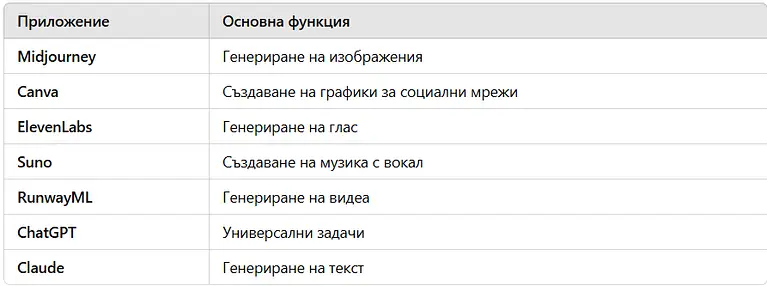
Popular AI applications (see table below):
What are the advantages and disadvantages of artificial intelligence?
AI technologies offer a wide range of benefits. They automate and streamline workflows, support better decision-making, analyze large volumes of data, make customer service easier, and improve the efficiency of marketing and sales, saving time, resources, and money along the way. The benefits fall into two groups: strategic ones that improve how the business runs overall, and tactical ones that make specific tasks easier, like writing copy.
The risks of AI are also widely discussed, mostly around protecting personal data, and major players like ChatGPT are actively working on this. For instance, you can turn off “algorithm training” in your account settings, or even sign a DPA (Data Processing Agreement), a contract that governs how your business’s data gets used.
Adopting artificial intelligence is a real challenge, since it requires a strategic choice among the many available solutions to avoid wasting money. The key is a thorough look at the business itself: identifying gaps, optimizing processes, and addressing resource shortages. AI is only “the tip of the iceberg” – the foundation underneath it is the business’s own philosophy and resilience.
What’s the future of AI?
Artificial intelligence is evolving fast, with frequent improvements reshaping the industry. Elon Musk, CEO of SpaceX, predicts AI will surpass individual human intelligence by 2025, and could surpass humanity’s combined intelligence by 2027-2028. Sundar Pichai, CEO of Google, expects major changes to Google Search in 2025 that will allow it to handle complex, intuitive queries with unmatched accuracy. In other words, some of the biggest names in the field agree: the future of AI is transformational.
Artificial intelligence is making its way into education, healthcare, customer service, manufacturing, and marketing. Still, there’s no single standard for how to integrate it. For some businesses, the topic remains a source of worry; for others, AI is a tool for survival and growth. Either way, the future of AI rests in the hands and minds of business leaders willing to approach it with the right amount of curiosity.
How is AI used in everyday life?
Artificial intelligence has burst into our everyday lives, with the ability to streamline repetitive tasks such as:
- Organizing household shopping and chores
- Planning flights and trips
- Optimizing meal plans
- Analyzing monthly budgets
- Preparing for a job interview
The list could go on forever, so we’ll stop here.
With the right mindset and a bit of creativity, artificial intelligence can become a helper for almost any everyday task. ChatGPT, for example, can help you learn a new language using a gamified approach, acting as your tutor and delivering knowledge in a fun way.
A prompt for that might look like this:
“Act as a teacher in Spanish language. My goal is to learn Spanish and improve my writing skills. My current level is A2 (insert your own level here). I want you to help me with this task by describing real-life situational examples, test my language and give me feedback all the time. Make sure the learning is gamified. FYI, my native language is English.”
It can also be a fun way to test your geography knowledge. Picture a game where it names a country and you have to guess its capital. Example prompt:
“Act as a game that tests my knowledge in country capitals. You’ll name a country, and I’ll have to guess the capital. If I give a wrong answer, you give me a little hint until I guess it. If I say “I give up”, then you tell me the right answer and you move to the next country.”
How is education changing under the influence of intelligent technology?
The education system faces a new challenge with the rise of AI. It has to strike a balance between controlling information, since every student now has access to chatbots, and adapting to the new technology. Some AI-powered platforms manage to personalize learning, offering extra material to interested students and help whenever it’s needed.
Teachers can automate parts of their work too. With an app like Perplexity, for instance, any teacher can research and fact-check information by searching the vast internet through AI. Preparing presentations is also easier than ever: apps like Gamma App build entire slide decks from a given text or topic. And ChatGPT itself can suggest good ideas for gamifying lessons and bringing in modern tactics to keep students engaged.
One of the biggest questions facing education is how to prepare students for the skills of the future. Working with artificial intelligence will be an unavoidable part of their everyday lives, which means developing critical thinking, solid digital literacy, and career guidance.
Will some jobs disappear?
The world is split into two camps: some believe AI will only ever be a “crutch,” while others think it will replace entire professions outright. The truth is probably somewhere in between. The fastest changes are expected in digital professions and customer service.
But alongside the risk come new opportunities. Demand is expected to grow for specialists who maintain AI systems, as well as for existing professions evolving to include AI, such as:
- Digital marketers who know how to write copy with AI
- Designers who produce a high volume of creative assets
- Video editors who streamline their workflow and save time with AI
All of this suggests that the first step is understanding how existing technologies can work for us. Used the right way, AI can strengthen our work and make us more effective at what we’re already good at. That’s why regularly refreshing your AI knowledge pays off.
How is AI regulated around the world?
AI regulation is one of the leading political and economic topics worldwide. The European Union is at the forefront with the world’s first AI law, known as the AI Act. It focuses on the “high-risk category,” which includes technologies like facial recognition or medical software, all subject to strict safety requirements. The law’s main goal is to ensure AI is used ethically. As expected, other major powers like the US and China are rolling out their own versions of AI safety standards too.
Ethical questions around artificial intelligence come up constantly in the digital and media world. One of the central questions is how to use AI while staying within ethical bounds. Good practice is to label content where AI played a substantial role (an AI-generated image, for example). Instagram has an “Add AI label” option for posts, which helps keep audiences informed and avoids misleading them.
The private sector carries real responsibility for shaping the AI ecosystem. Businesses themselves need to start upholding the standards they promise their customers: honesty, ethics, and transparency. Since AI is still a relatively new step for the wider world, every player – public, private, or nonprofit – has a part to play in shaping the good practices that get passed on from here.
Artificial intelligence is driving change across nearly every industry, and it seems to have caught the world somewhat unprepared. Where we once saw a generational gap in how effectively people used the internet and social media, today an entirely new digital chapter is opening up in front of us. Each of us carries the responsibility to write it carefully, with an eye toward building a better world.
What is artificial intelligence and how does it work?
Artificial intelligence (AI) is the ability of machines to perform tasks that normally require human intelligence – solving problems, understanding language, and recognizing objects, for example. That’s why AI chatbots have become so popular in business and everyday life: they function like an “intern sitting at the next desk,” ready to carry out instructions.
When we talk about artificial intelligence, it’s worth focusing on two key technologies behind its power: machine learning and natural language processing. What exactly are they? Let’s find out.
- Machine learning: the development of algorithms that let machines learn from data and make predictions. For example, just as a person looks at a canvas of paint and recognizes it as a painting, identifying its style and genre from past experience, artificial intelligence can recognize that a given piece of text is written for posting on LinkedIn.
- Natural language processing: this technology lets artificial intelligence understand and use human language. Thanks to NLP, we can talk to chatbots almost as if they were human.
Artificial intelligence is trained on huge volumes of data, and even our own interactions with chatbots help it improve. The more data AI processes, the more accurate its results become.
There are two main types of artificial intelligence: narrow and general. Narrow AI is built to perform specific tasks within a limited context, like Apple’s voice assistant Siri. General AI, on the other hand, can handle a much wider range of tasks, as with ChatGPT.
How has AI developed in recent years?
Artificial intelligence isn’t new, even though it became a hot topic after ChatGPT arrived in late 2022. The idea of machine thinking dates back to 1950, when British mathematician Alan Turing proposed the concept of machine intelligence in his paper “Can a Machine Think?” In it, he also described the Turing test, a method for evaluating a computer’s intelligence.
Another key moment in the history of artificial intelligence was the chess match between Garry Kasparov and IBM’s Deep Blue. Kasparov won in 1996, but a year later Deep Blue became the first computer to beat a reigning world champion in a straight match. That event changed how we thought about what machines could do.
Today artificial intelligence is evolving at enormous speed. ChatGPT laid the groundwork with text conversations, later adding features like image generation and voice commands. New technologies followed, such as:
- Text-to-image: Midjourney, Dall-E, Stable Diffusion.
- Text-to-voice: ElevenLabs.
- Text-to-video: RunwayML, InVideo, Kling AI
Bulgaria has its own point of pride with BgGPT, the first European chatbot built specifically for the Bulgarian language by INSAIT. By March 2024, BgGPT had answered more than 2 million queries, offering a localized alternative to ChatGPT.
Popular AI applications (see table below):
What are the advantages and disadvantages of artificial intelligence?
AI technologies offer a wide range of benefits. They automate and streamline workflows, support better decision-making, analyze large volumes of data, make customer service easier, and improve the efficiency of marketing and sales, saving time, resources, and money along the way. The benefits fall into two groups: strategic ones that improve how the business runs overall, and tactical ones that make specific tasks easier, like writing copy.
The risks of AI are also widely discussed, mostly around protecting personal data, and major players like ChatGPT are actively working on this. For instance, you can turn off “algorithm training” in your account settings, or even sign a DPA (Data Processing Agreement), a contract that governs how your business’s data gets used.
Adopting artificial intelligence is a real challenge, since it requires a strategic choice among the many available solutions to avoid wasting money. The key is a thorough look at the business itself: identifying gaps, optimizing processes, and addressing resource shortages. AI is only “the tip of the iceberg” – the foundation underneath it is the business’s own philosophy and resilience.
What’s the future of AI?
Artificial intelligence is evolving fast, with frequent improvements reshaping the industry. Elon Musk, CEO of SpaceX, predicts AI will surpass individual human intelligence by 2025, and could surpass humanity’s combined intelligence by 2027-2028. Sundar Pichai, CEO of Google, expects major changes to Google Search in 2025 that will allow it to handle complex, intuitive queries with unmatched accuracy. In other words, some of the biggest names in the field agree: the future of AI is transformational.
Artificial intelligence is making its way into education, healthcare, customer service, manufacturing, and marketing. Still, there’s no single standard for how to integrate it. For some businesses, the topic remains a source of worry; for others, AI is a tool for survival and growth. Either way, the future of AI rests in the hands and minds of business leaders willing to approach it with the right amount of curiosity.
How is AI used in everyday life?
Artificial intelligence has burst into our everyday lives, with the ability to streamline repetitive tasks such as:
- Organizing household shopping and chores
- Planning flights and trips
- Optimizing meal plans
- Analyzing monthly budgets
- Preparing for a job interview
The list could go on forever, so we’ll stop here.
With the right mindset and a bit of creativity, artificial intelligence can become a helper for almost any everyday task. ChatGPT, for example, can help you learn a new language using a gamified approach, acting as your tutor and delivering knowledge in a fun way.
A prompt for that might look like this:
“Act as a teacher in Spanish language. My goal is to learn Spanish and improve my writing skills. My current level is A2 (insert your own level here). I want you to help me with this task by describing real-life situational examples, test my language and give me feedback all the time. Make sure the learning is gamified. FYI, my native language is English.”
It can also be a fun way to test your geography knowledge. Picture a game where it names a country and you have to guess its capital. Example prompt:
“Act as a game that tests my knowledge in country capitals. You’ll name a country, and I’ll have to guess the capital. If I give a wrong answer, you give me a little hint until I guess it. If I say “I give up”, then you tell me the right answer and you move to the next country.”
How is education changing under the influence of intelligent technology?
The education system faces a new challenge with the rise of AI. It has to strike a balance between controlling information, since every student now has access to chatbots, and adapting to the new technology. Some AI-powered platforms manage to personalize learning, offering extra material to interested students and help whenever it’s needed.
Teachers can automate parts of their work too. With an app like Perplexity, for instance, any teacher can research and fact-check information by searching the vast internet through AI. Preparing presentations is also easier than ever: apps like Gamma App build entire slide decks from a given text or topic. And ChatGPT itself can suggest good ideas for gamifying lessons and bringing in modern tactics to keep students engaged.
One of the biggest questions facing education is how to prepare students for the skills of the future. Working with artificial intelligence will be an unavoidable part of their everyday lives, which means developing critical thinking, solid digital literacy, and career guidance.
Will some jobs disappear?
The world is split into two camps: some believe AI will only ever be a “crutch,” while others think it will replace entire professions outright. The truth is probably somewhere in between. The fastest changes are expected in digital professions and customer service.
But alongside the risk come new opportunities. Demand is expected to grow for specialists who maintain AI systems, as well as for existing professions evolving to include AI, such as:
- Digital marketers who know how to write copy with AI
- Designers who produce a high volume of creative assets
- Video editors who streamline their workflow and save time with AI
All of this suggests that the first step is understanding how existing technologies can work for us. Used the right way, AI can strengthen our work and make us more effective at what we’re already good at. That’s why regularly refreshing your AI knowledge pays off.
How is AI regulated around the world?
AI regulation is one of the leading political and economic topics worldwide. The European Union is at the forefront with the world’s first AI law, known as the AI Act. It focuses on the “high-risk category,” which includes technologies like facial recognition or medical software, all subject to strict safety requirements. The law’s main goal is to ensure AI is used ethically. As expected, other major powers like the US and China are rolling out their own versions of AI safety standards too.
Ethical questions around artificial intelligence come up constantly in the digital and media world. One of the central questions is how to use AI while staying within ethical bounds. Good practice is to label content where AI played a substantial role (an AI-generated image, for example). Instagram has an “Add AI label” option for posts, which helps keep audiences informed and avoids misleading them.
The private sector carries real responsibility for shaping the AI ecosystem. Businesses themselves need to start upholding the standards they promise their customers: honesty, ethics, and transparency. Since AI is still a relatively new step for the wider world, every player – public, private, or nonprofit – has a part to play in shaping the good practices that get passed on from here.
Artificial intelligence is driving change across nearly every industry, and it seems to have caught the world somewhat unprepared. Where we once saw a generational gap in how effectively people used the internet and social media, today an entirely new digital chapter is opening up in front of us. Each of us carries the responsibility to write it carefully, with an eye toward building a better world.
More from the blog
All articles